内容简介
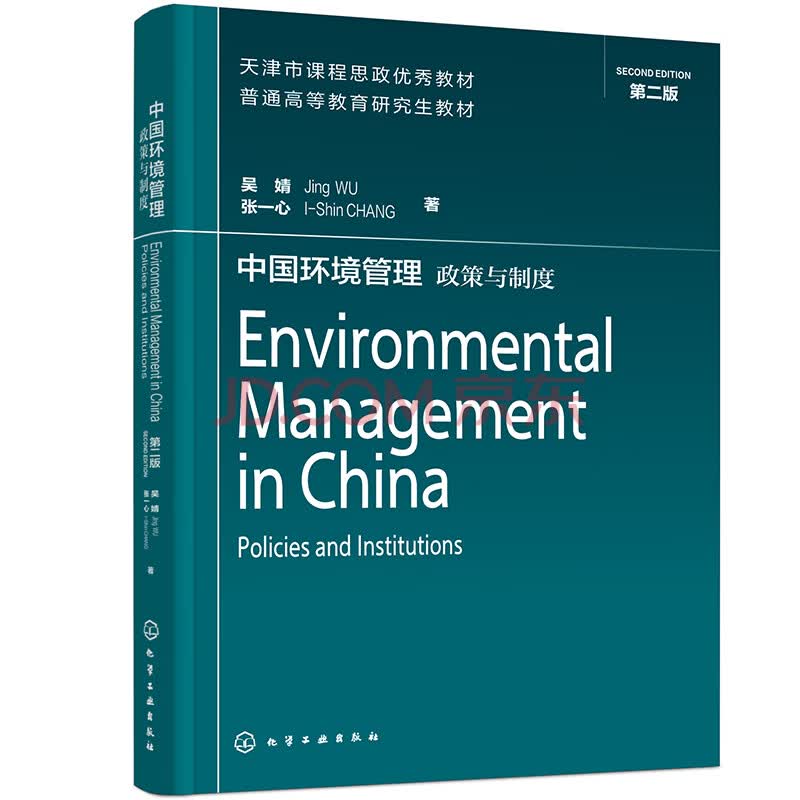
《中国环境管理:政策与制度》(Environmental Management in China: Policies and Institutions)全面系统总结了中国当代环境管理政策与制度的发展历程,生动展现真实、立体的中国环境管理全貌,为推动“一带一路”绿色发展传播中国声音。全书共19章,第1章是环境管理行政管理的演变;第2章阐述了环境管理指导思想的产生和发展;第3章至第16章介绍我国主要环境管理政策与制度的发展历程、特点及其成效,包括环境规划制度、环境影响评价制度、“三同时”制度、排污收费和环境保护税制度、环境保护目标责任制、排污许可制度、污染集中控制、总量控制制度、公众参与制度与环境信息公开制度、生态环境分区管控制度、区域联防联控、生态环境损害赔偿制度、清洁生产制度、生态补偿制度等;从第17章到第19章,介绍了我国环境保护在大气、水和土壤方面的重要任务。最后给出了主要法律、法规、条例、措施等的中英文对照表,以供参考。
本书可供高等院校环境专业学生作为教材使用,还可供从事环境保护、环境管理等领域的科研人员阅读参考。
前言/序言
Preface to the Second Edition
After the first edition of this book, corresponding MOOC (Massive Open Online Course) was developed and placed on various online education platforms, such as “XUETANGX” and “MOOC of China’s Universities”. Through online videos and courseware, richer content and interaction data support are provided for teaching process, and the multivariate and diversity of teaching process are enhanced. Teaching resources are dynamic updated on the online education platforms, so as to establish the professional teaching resources databases to ensure the dynamic updating of teaching materials. In addition, the learning track, school work, test grade, etc., will be statistically analyzed to understand the comprehensive development of students and provide feedback for lecturers, through whole process monitoring and evaluation, and examining system of the online education platforms. In 2021, this Book was awarded “Tianjin Excellent Textbook Award”.
In responding to the requirement of integrating the ideology of socialism with Chinese characteristics in the new era into teaching materials, the goal of the second edition of this book is to cultivate innovative talent to serve National Ecological Civilization Construction, to deeply integrate the ideological politics into professional knowledge learning and professional capacity cultivation, and to fully demonstrate the accomplishment of environmental management in China, particularly in the aspect of policies and institution, where not only the advancement and scientificity of knowledge, but also the systematicness and integrity of knowledge structure are both emphasized to explain profound theories in simple terms with concise content, and in accordance with the need of practical application.
Jing WU
I-Shin CHANG
Preface to the First Edition
In China, environmental protection work was formally commenced in 1973. Through continuous learning process of exploration, execution, review and amendment on the implementation of environmental protection work, a set of environmental management system, conforming to China’s national conditions, has been gradually established to provide effective assurance for strengthening environmental protection. During the initial stage of China’s environmental protection work, from 1973 to 1979, the ‘Three Synchronizations,’ the ‘Environmental Impact Assessment,’ and the ‘Emission Fees for Noncompliance,’ also known as the ‘Three Old Management Schemes,’ were put forward and implemented to found the basis of administrative management system for China’s environmental protection work and to denote the institutionalization of China’s environmental protection work. In addition, the Three Old Management Schemes had generated significant effects on pollution prevention and control for existing and new pollution sources to greatly promote the establishment and execution of China’s environmental protection work. In 1989, during the Third National Conference on Environmental Protection, through the experience learned from the practice of environmental protection work and the establishment of environmental management system, the idea that the pathway of China’s environmental protection work should be in line with China’s national conditions was put forward. Thus, five different environmental management schemes, including the ‘Liability System for Environmental Protection Objectives,’ the ‘Quantitative Performance Evaluation on Comprehensive Environmental Governance for Urban Environment,’ the ‘Centralization of Pollution Control,’ ‘Deadline for Pollution Governance,’ and the ‘Emission Permit,’ also known as the ’Five New Management Schemes,’ were promulgated. And the basic institutional framework of China’s environmental management was then founded on these eight environmental management schemes, including the Three Old Management Schemes and the Five New Management Schemes.
Into the 21st century, as the emphasis of environmental protection was gradually shifted from governing pollution to improving environmental quality and promoting environmental service functions, the orientation of environmental management was inevitably adjusted from pollution control to the enhancement of environmental quality. And, the perception of environmental protection was then changed from abating pollution to preventing pollution, including: to put environmental protection first, to promote environmental service functions and to enhance the production capacity of ecological goods. Consequently, several effective environmental management systems and measures were progressively promulgated and implemented. For example, in the ‘Total Emission Cap,’ emission cap was determined for major pollutants as the binding indicator to be incorporated into the National Economic and Social Development Plan. In the ‘Environmental Monitoring and Emergency Response Management System,’ six regional Environmental Protection Supervision Centers, including North, East, South, North East, North West and South West, were set up, directly under the Ministry of Environmental Protection (the MEP), to deal with the cross-regional and cross-watershed environmental regulatory issues. In the Law of the People’s Republic of China on Promoting Cleaner Production and the Law of the People’s Republic of China on Promoting Circular Economy, pollution control on sources and processes was stipulated. In the ‘Information Disclosure and Public Participation,’ environmental information disclosure and public participation in environmental impact assessment were continuously strengthened. In the ’Environmental Economy Policy System,’ a framework consisting of green credit, insurance, trade, price of electricity, stock, taxation and etc. was constructed preliminarily. Meanwhile, some environmental management schemes incompatible with social and economic development were gradually phased out. For example, ‘Quantitative Performance Evaluation on Integrated Environmental Governance for Cities’ was terminated in 2012; and the ‘Deadline for Pollution Governance’ was deleted from the 2014 Amendment of the Law of the People’s Republic of China on Environmental Protection (the EP Law 2014).
Jing WU
I-Shin CHANG