内容简介
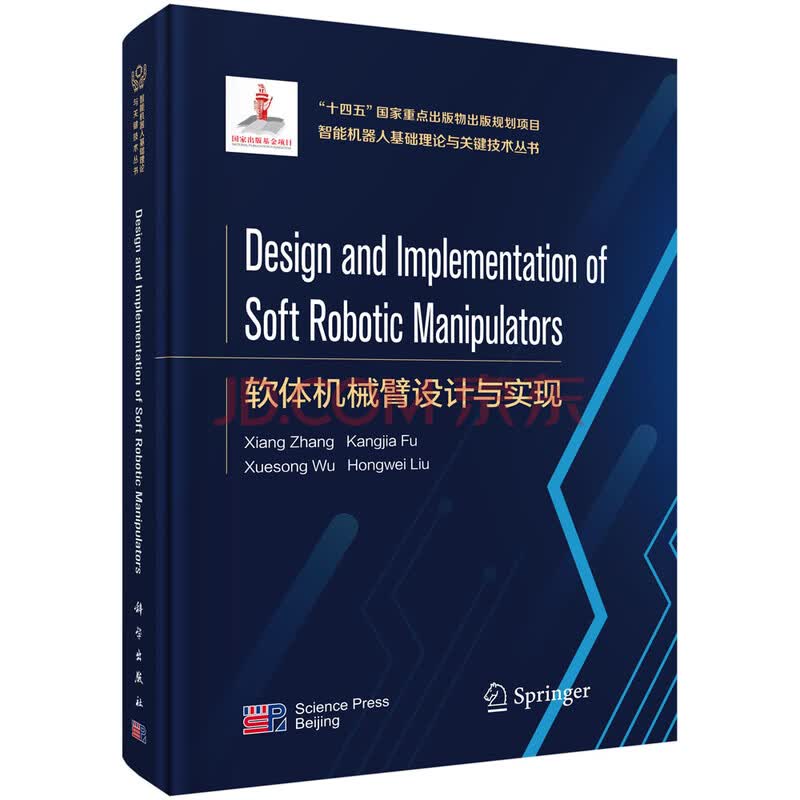
柔性机械臂是一种利用柔性材料或柔性结构并通过连续运动控制来完成操作任务的特殊机械臂,具有重量轻、灵活、物理交互安全等优点,在工业和家庭应用中都显示出广阔的前景。在Web of Science数据库中,“柔性机械臂”、“软体机械臂”、“柔性手”等搜索词或搜索范围呈现出蓬勃发展的趋势。《Design and Implementation of Soft Robotic Manipulators(软体机械臂设计与实现)》详细研究了柔性机械臂,包括对柔性机械臂的系统回顾,结构和驱动的集成设计,柔性机械臂的建模和实现、结构优化和实验验证。《Design and Implementation of Soft Robotic Manipulators(软体机械臂设计与实现)》从设计,仿真到实验验证,深刻阐述了对柔性机械臂的精细控制和有效应用方法。
目录
Contents
1 Review of Soft Manipulator Research, Applications and Opportunities 1
1.1 Related Literature Analysis 2
1.2 Research Status of Soft Manipulator 4
1.2.1 Fluid-Driven Mode 4
1.2.2 Cable-Driven Mode 7
1.2.3 Electroactive Polymer-Driven Mode 8
1.2.4 Shape Memory Materials-Driven Mode 10
1.2.5 Electromagnetic-Driven Mode 11
1.2.6 Hybrid Drive Mode 12
1.2.7 Comparison of Different Drive Modes 14
1.3 Enabling Technologies of the Soft Manipulator 15
1.3.1 Kinematic and Dynamic Modeling 18
1.3.2 Motion Control 21
1.3.3 Shape Detection 23
1.3.4 Dynamic Tactile Perception 25
1.3.5 Stiffening Method of Soft Structure 28
1.4 Opportunities and Challenges of Soft Manipulator in Application 30
1.5 Summary 34
References 35
2 Design and Development of an Elephant Trunk-Like Soft Robotic Manipulator 47
2.1 Design of a Pneumatic Soft Actuator 47
2.1.1 Design Schematic 47
2.1.2 Kinematic Model of the Soft Actuator 48
2.1.3 Determination of Elastic Stiffness of the Soft Actuator 52
2.2 Design and Development of the Soft Manipulator 54
2.2.1 Kinematic Model of the Soft Manipulator 54
2.2.2 Simulation and Analysis 56
2.3 Experiment Analysis 59
2.3.1 Development of the Experiment System 59
2.3.2 Experimental Results Analysis 61
2.4 Summary 64
References 64
3 Design and Optimization of a Pneumatic Soft Actuator 67
3.1 Model Parameterization 68
3.1.1 Geometric Model and Physical Process Description 68
3.1.2 Structural Parameterization 68
3.2 Structural Analysis and Optimization Design Method 69
3.2.1 Structural Analysis Method 69
3.2.2 Optimization Design Method 75
3.2.3 Determination Method of the Material Constitutive Model 78
3.3 Sensitivity Analysis of Structural Parameters 80
3.3.1 Initial Parameter Value and Design Range 81
3.3.2 Single Factor Impact Analysis: Inclination Angle 82
3.3.3 Univariate Factor Impact Analysis: Reaction Force 85
3.3.4 Analysis Conclusion 86
3.4 Structural Optimization and Performance Evaluation 88
3.4.1 Establishment of Global Objective Function 88
3.4.2 Calculation of the Maximum Value of the Univariate Objective 89
3.4.3 Implementation of Global Optimization 90
3.4.4 Optimization Results of Pneumatic Manipulator 92
3.5 Summary 94
References 94
4 Experimental Validation of a Composite Soft Actuator 97
4.1 Shape Deformation Simulation and Experiment 97
4.1.1 FEM Simulation in ABAQUS 97
4.1.2 Design of Pneumatic Experiment System 98
4.1.3 Experimental Validation 98
4.2 Implementation Analysis of the Pneumatic Actuator 101
4.2.1 Tensile Damage Analysis 101
4.2.2 Pulling Force Analysis 103
4.3 Summary 105
References 105
5 Improved Design of the Variable Cross-Section for the Trunk-Like Soft Manipulator 107
5.1 The Improved Structure Design of the Variable Cross-Section for the Trunk-Like Soft Manipulator 109
5.2 Path Planning and Pressure Control of the Soft Manipulator 113
5.2.1 Simplified Model Based on Experimental Data 113
5.2.2 Path Planning and Control Based on Optimization Algorithm 118
5.3 Principle Prototype and Test System 124
5.3.1 Principle Prototype Design and Development 124
5.3.2 Upper Computer Control System 126
5.4 Soft Manipulator Control Test 132
5.4.1 Spiral Winding Movement 133
5.4.2 The Four-Leaf Clover Movement 135
5.4.3 The Pendulum Swings Movement from Side to Side 136
5.4.4 The Horizontal Plane Swings from Side to Side and Bends Upward Movement 139
5.4.5 Fixed Point Movement and Target Capture 141
5.5 Summary 143
References 144
6 Kinematic Modeling and Experimental Validation of a Foldable Pneumatic Soft Module 147
6.1 Kinematic Modeling of the Foldable Pneumatic Soft Manipulator 147
6.1.1 Design Schematic 147
6.1.2 Kinematic Model of the Foldable Pneumatic Module 149
6.2 Numerical Calculation and Analysis 154
6.2.1 Model Parameters 154
6.2.2 Shape Deformation of the Pneumatic Module 155
6.2.3 Workspace of the Pneumatic Module 156
6.3 Experiment Design and Validation 157
6.3.1 Experiment Design 157
6.3.2 Repeatability Test of the Pneumatic Module 158
6.3.3 Validation of the Model Prediction Accuracy 160
6.4 Summary 164
References 164
7 Design, Modeling and Implementation of a Foldable Pneumatic Soft Manipulator 167
7.1 Design of the Foldable Pneumatic Soft Manipulator 168
7.2 Kinematic Modeling of the Soft Manipulator 169
7.2.1 Kinematic Model 169
7.2.2 Numerical Calculation and Analysis 172
7.3 Implementation and Experimental Validation 176
7.3.1 Experiment Design 176
7.3.2 Experimental Validation of the Soft Manipulator 180
7.4 Inverse Kinematic Modeling for Overall Shape Prediction of Soft Manipulators 182
7.4.1 Coordinate Frames Definition 183
7.4.2 Equivalent Simplification and Data Preparation 186
7.4.3 Model Organization 187
7.4.4 Model Performance and
试读
Chapter 1 Review of Soft Manipulator Research,Applications and Opportunities
Dexterous manipulation is one of the primary goals in robotics [1]. Inspired by the movement of soft tissues such as the elephant trunk and octopus's tentacles,the soft manipulator is a kind of special manipulator that uses soft materials or flexible structure to perform manipulation tasks through continuous motion control under the action of specific continuous drive mode. The definition of soft material is based on the elastic modulus of the biological tendon (about 1 GPa),which can be regarded as soft material if it is less than 1 GPa [2]. It is an under-actuated system that performs infinite freedom motion through limited control variables [3,4],which is essentially different from the rigid manipulator [5]. The control variables of soft manipulators are closely related to their drive modes. At present,the main drive modes include fluid drive,cable drive,smart material drive,electromagnetic drive and so on [2]. The fluid drive is the use of air pressure or hydraulic pressure to drive the deformation of the capsule. The cable drive is the use of motors to control the cables. The smart material drive is actuated by the deformation of smart materials or structures through the change of voltage or current [6]. The electromagnetic drive is the use of the external controllable magnetic field to drive the ferromagnet.
As an important component of the soft robot,the soft manipulator is developing step by step with the fast development of the soft robot. According to different drive modes,the relevant-typical design cases of the soft manipulators are investigated. In terms of fluid-driven mode,Wehner et al. [7] designed and developed an entirely soft robot Octobot by using a multi-material,embedded 3D printing technique. Sanan et al. [8,9] designed and developed an arm-like soft manipulator PneuArm,which was composed of multiple air bags stacked and assembled in a complex way,without any rigid skeleton structure. Chitrakaran et al. [10,11] designed and developed a soft manipulator OctArm imitating the tentacle of the octopus. In terms of the cable-driven mode,Dong et al. [12-14] developed a slender continuous soft manipulator,which was mainly used for nondestructive testing and the inspection of aerogine. Li et al. [15] designed and developed a cable-driven continuous backbone robot,which was composed of a bendable backbone and a series of circular plates with holes. Giorelli et al. [16,17] designed and developed a soft manipulator imitating
octopus tentacle,in which 12 strings were embedded into the soft silica gel. In terms of smart material-driven mode,Kovacs et al. [18] designed and developed a stacked dielectric elastomer actuator,which was made by brushing graphite electrode on the dielectric elastomer film and then stacking the film into a cylindrical actuator. Pei et al. designed and developed a multiple-degrees-of-freedom electroelastomer roll actuator by rolling highly prestrainned electroelastomer films around a compression spring [19,20]. Cianchetti et al. [21,22] designed and developed an octopus like soft manipulator inspired by the biological mechanism of the octopus' tentacle. In terms of electromagnetic-driven mode,Kim et al. [23] designed and developed a ferromagnetic soft continuum robot,which was mainly used for minimally invasive cleaning of blood vessels,based on their existing technologies such as programmable magnetic printing [24] and hydrogel bioelectronics devices [25]. Jeon et al. designed and developed a magnetically controlled soft microbot,which was supported by a complex external electromagnetic mechanism [26,27]. All these above investigations indicate that the researches of soft manipulators have attracted worldwide interest and far-reaching influence.
In this chapter,a review of research progresses,applications and opportunities of the soft manipulators is summarized and analyzed through plentiful literature investigations. Firstly,the typical design cases of the soft manipulators are systematically classified according to the drive modes. The performances of different drive modes are compared and analyzed. Then,the enabling technologies involved in the research of the soft manipulator are discussed from the aspects of modeling and control,the shape detection and dynamic tactile sensing,the stiffening method,and so on. Finally,the current application fields of the soft manipulator as well as its opportunities and challenges in the newly booming fields are analyzed and described.
1.1 Related Literature Analysis
In the Web of Science database,"soft manipulator","soft robot arm" and "soft arm" are used as the search terms and the search scope is "theme",covering the period from 2000 to April 2021. Irrelevant research directions were excluded,with a total of 4970 records detected. Figure 1.1 shows the current research subjects and research hotspots of soft manipulators. Citespa