内容简介
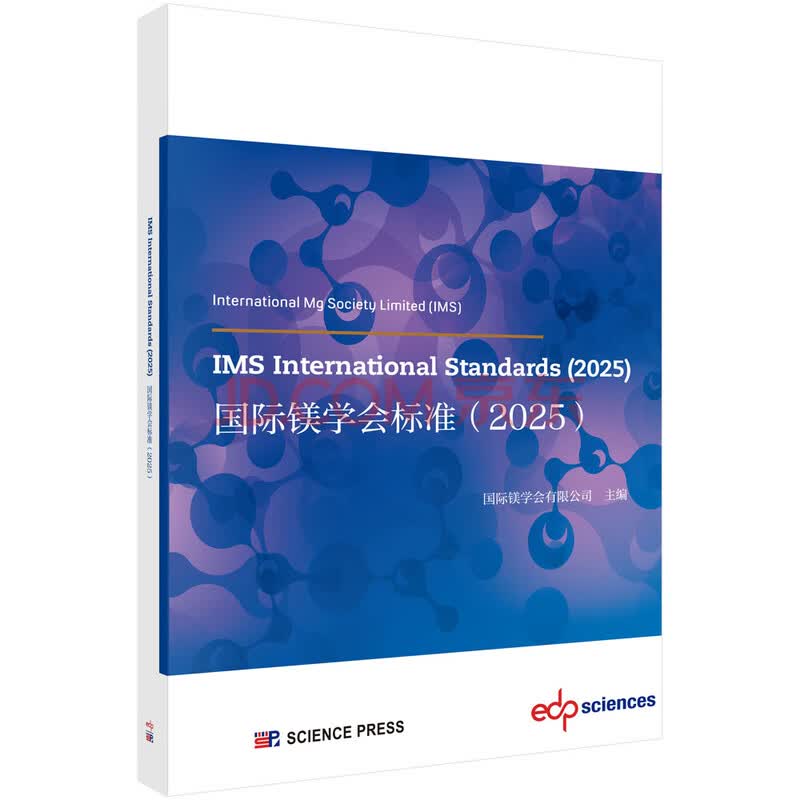
The International Mg Society (IMS) is a non-profit organization. The purpose of IMS is to promote research, development, and applications of magnesium and its alloys, and to provide an academic exchange platform for all the magnesium scientists and engineers. The president of IMS is Prof. Fusheng Pan. Vice presidents of IMS are Prof. Karl Ulrich Kainer (Germany), Prof. Alan Luo (USA), and Prof. Kwang Seon Shin (Korea). IMS holds international conferences on magnesium and supports the publication and presentation of scientific results. Journal of Magnesium and Alloys is the official journal for IMS. IMS standards are prepared by International Magnesium Alloys Advanced Materials Technology Limited (HK, China), the secretariat of the Information Committee on IMS, and prepared by IMS members. IMS standards are published and served for all parts concerned with Magnesium in the world and are to be modified with help from anybody in the industry chain on magnesium. Any trade name used in this.
目录
Contents
Editorial Board III
Acknowledgement III
Foreword V
CHAPTER 1
IMS 001-2024 Magnesium and Magnesium Alloys — Terms and Definitions of Surface Treatment 1
1.1 Scope 1
1.2 Terms and Definitions 1
1.2.1 Basic Terminology 1
1.2.2 Surface Treatment 2
1.2.3 Performance 10
1.2.4 Testing and Evaluation 13
CHAPTER 2
IMS 002-2024 Magnesium and Magnesium Alloys–Powder Coating Selection Guide for Magnesium Surface Spraying 17
2.1 Scope 17
2.2 Normative References 17
2.3 Powder Type and Coating Characteristics 17
2.4 Applicable Environment, Product, and Coating of Powder 17
2.4.1 Environment Type and Suitable Coating 17
2.4.2 Product Field and Suitable Powder Type 17
2.4.3 Coating Color and Suitable Powder 17
2.5 Quality Assurance 21
2.6 Quality Assurance Certificate 21
2.7 Purchase Order (or Contract) 22
Appendix A 23
CHAPTER 3
IMS 003-2024 Magnesium and Magnesium Alloys–Paint Coating Selection Guide for Magnesium Surface Spraying 27
3.1 Scope 27
3.2 Normative References 27
3.3 Structure and Characteristics of Various Coatings 27
3.3.1 Structure and Characteristics of Electrophoretic Coating 27
3.3.2 Structure and Characteristics of Spraying Coating 27
3.4 Applicable Environment and Suitable Coating 27
3.5 Coating Performance 31
3.5.1 General Requirements 31
3.5.2 Appearance Quality 31
3.5.3 Gloss 31
3.5.4 Color and Color Difference 32
3.5.5 Coating Thickness 32
3.5.6 Salt Spray Corrosion Resistance 32
3.5.7 Corrosion Resistance to Sulfur Dioxide Humid Atmosphere 32
3.5.8 Filiform Corrosion Resistance 32
3.5.9 Machu Corrosion Resistance 32
3.5.10 Humidity and Heat Resistance 32
3.5.11 Acid Resistance 32
3.5.12 Alkali Resistance 32
3.5.13 Mortar Resistance 33
3.5.14 Solvent Resistance 33
3.5.15 Detergent Resistance 33
3.5.16 Weatherability 33
3.5.17 Coating Hardness 33
3.5.18 Abrasion Resistance 33
3.5.19 Adhesion 33
3.5.20 Impact Resistance 33
3.5.21 Cupping Resistance 34
3.5.22 Bending Resistance 34
3.5.23 Boiling Water Resistance 34
3.6 Test Methods 34
3.6.1 Appearance Quality Test Method 34
3.6.2 Gloss Measurement Method 34
3.6.3 Color and Color Difference Inspection Method 34
3.6.4 Coating Thickness Test Method 34
3.6.5 Salt Spray Corrosion Test Method 34
3.6.6 Sulfur Dioxide Humid Atmosphere Corrosion Test Method 35
3.6.7 Filiform Corrosion Resistance Test Method 35
3.6.8 Machu Test Method 35
3.6.9 Damp Heat Test Method 35
3.6.10 Acid Resistance Test Method 35
3.6.11 Alkali Resistance Test Method 35
3.6.12 Mortar Resistance Test Method 36
3.6.13 Solvent Resistance Test Method 36
3.6.14 Detergent Resistance Test Method 36
3.6.15 Weatherability Test Method 36
3.6.16 Coating Hardness Test Method 37
3.6.17 Abrasion Resistance Test Method 37
3.6.18 Adhesion Test Method 37
3.6.19 Impact Resistance Test Method 37
3.6.20 Cupping Resistance Test Method 37
3.6.21 Bending Resistance Test Method 37
3.6.22 Boiling Water Resistance Test Method 38
3.7 Quality Certificate 38
3.7.1 Quality Certificate of Electrophoretic Coating 38
3.7.2 Quality Certificate of Spraying Coating 38
3.8 Contents of Purchase Order (or Contract) 38
3.8.1 Contents of the Electrophoretic Coating Purchase Order (or Contract) 38
3.8.2 Content of Spraying Coating Purchase Order (or Contract) 39
CHAPTER 4
IMS 004-2025 Magnesium and Magnesium Alloys–Extruded Profiles for Rail Transit Equipment 41
4.1 Scope 41
4.2 Normative References 41
4.3 Terms and Definitions 41
4.4 Orders or Tenders 41
4.5 Requirements 42
4.5.1 Designation 42
4.5.2 Production and Manufacturing Processes 42
4.5.3 Quality Control 42
4.5.4 Chemical Composition 42
4.5.5 Mechanical Properties 42
4.5.6 Surface Finish 45
4.5.7 Tolerances on Shape and Dimensions 45
4.6 Test Procedure 53
4.6.1 Sampling 53
4.6.2 Test Methods 54
4.6.3 Retests 55
4.7 Inspection Documents 55
4.7.1 General 55
4.7.2 Certificate of Conformity 55
4.7.3 Test Report 55
4.8 Marking 55
4.9 Packing 56
4.10 Transportation and Storage 56
4.11 Arbitration Tests 56
Bibliography 56
CHAPTER 5
IMS 005-2025 Magnesium and Magnesium Alloys–Soluble Magnesium Alloy Materials for Downhole Tools 57
5.1 Scope 57
5.2 Normative References 57
5.3 Terms and Definitions 57
5.4 Requirements 57
5.4.1 Designation 57
5.4.2 Quality Control 58
5.4.3 Chemical Composition 58
5.4.4 Room-Temperature Tensile Mechanical Properties 58
5.4.5 Dissolution Rate 58
5.4.6 Macrostructure 58
5.4.7 Ultrasound Flaw Detection 60
5.4.8 Surface Quality 60
5.5 Test Procedure 61
5.5.1 Chemical Composition 61
5.5.2 Room-Temperature Tensile Mechanical Properties 61
5.5.3 Dissolution Rate 61
5.5.4 Macrostructure 61
5.5.5 Ultrasound Flaw Detection 61
5.5.6 Surface Quality 61
5.
试读
Chapter 1
Magnesium and Magnesium Alloys–Terms and Definitions of Surface Treatment
1.1 Scope
This document specifies the terms and definitions of surface treatment of magnesium and magnesium alloys,including basic terminology,surface treatment,performance,testing,and evaluation.
It applies to the surface treatment of magnesium and magnesium alloys.
1.2 Terms and Definitions
For this document,the following terms and definitions apply.
1.2.1 Basic Terminology
1.2.1.1 Chemical Conversion
Chemical conversion is the process of forming a chemical oxide coating on magnesium in an oxidizing chemical solution,formerly known as chemical oxidation.
1.2.1.2 Anodic Oxidation/Anodizing
Anodic oxidation/anodizing is an electrochemical oxidation process. In this process,a ceramic oxide coating is formed on the surface of magnesium or magnesium alloy through electrochemical action,with magnesium or magnesium alloy serving as the anode and stainless steel or carbon serving as the cathode. The coating has protective,decorative,or other functional characteristics.
1.2.1.3 Micro-Arc Oxidation
Micro-arc oxidation (MAO) is the anodic oxidation of the high-voltage area in the plasma discharge area. The micro-arc generated on the electrode surface is used to sinter the oxide coating on the electrode surface to form a ceramic oxide coating. In the MAO treatment,the obvious arc discharge appears at the interface between the electrode and the solution. It is also called plasma electrolytic oxidation (PEO),anodic spark deposition (ASD),or Arc-anodizing deposition (AAD).
1.2.1.4 Electroplating (Electrodeposition)
Electroplating is the process of depositing a metal or alloy coating on the substrate by electrolysis to obtain the properties or dimensions that the substrate metal does not have. It is also called electrodeposition.
1.2.1.5 Electroless Plating (Chemical Plating)
Electroless plating is the process of depositing a metal or alloy coating by a chemical method rather than an electrolytic method. It is also called chemical plating.
1.2.1.6 Painting
Painting is the process of coating paint on the substrate surface to form a protective,decorative,or specific functional coating.
1.2.1.7 Thermal Spraying
Thermal spraying is the process of forming a coating by spraying the heated spraying materials onto the surface of the pretreated magnesium and magnesium alloy substrate.
Note 1:The spraying materials can be alloy materials,ceramic materials,or alloy-ceramic composite materials.
Note 2:The spraying materials are heated to a plastic or molten state inside or outside the spraying gun.
Note 3:To obtain special coating performance,post-spraying heat treatment,mechanical treatment,or sealing treatment can be adopted.
1.2.1.8 Activation
Activation is the process of removing passivated surface conditions.
1.2.1.9 Stripping
Stripping is the process of removing anodic oxide coating,chemical conversion coating,or coating from the surface of magnesium and its alloys.
1.2.1.10 Surface Preconditioning
Surface preconditioning refers to the mechanical and chemical treatment,such as cleaning,activating,and polishing,of the substrate surface to adjust the surface state before pretreatment or coating.
1.2.1.11 Pretreatment
Pretreatment is the process of forming a thin coating layer on the substrate surface by physical,chemical,and electrochemical methods after conditioning. Generally,it can be used as a pretreatment of organic coating or used alone.
1.2.1.12 Self-Healing Coating
The self-healing coating is a coating that can heal the morphology or performance by itself once the coating is broken.
1.2.1.13 Surface Composite Treatment
Surface composite treatment is the process of combining two or more surface treatment technologies in an appropriate order and method,or manufacturing composite coatings based on a certain surface technology.
1.2.2 Surface Treatment
1.2.2.1 Degreasing
Degreasing is the process of removing grease from magnesium and its alloy surfaces by mechanical,chemical,or electrolytic methods.
1.2.2.2 Emulsion Degreasing
Emulsion degreasing is the process of removing grease from magnesium and magnesium alloys surfaces with an emulsion cleaner.
1.2.2.3 Organic Solvent Degreasing
Organic solvent degreasing is the process of degreasing magnesium and magnesium alloys surface with an organic solvent.
1.2.2.4 Mechanical Surface Treatment
Mechanical surface treatment is the process of removing foreign matter from the surface of magnesium and magnesium alloys substrate by using manual tools,power tools,or spraying,shot blasting,granulation,etc.
1.2.2.5 Chemical Surface Treatment
Chemical surface treatment is the process of removing the oxide scale and oil stain on the surface of magnesium and magnesium alloys by ch